

Transform Your Business with Reliable Cloud Services
Cloud Services Overview: Understanding Business Cloud Computing Platforms and SaaS Solutions
Cloud services are central to businesses aiming to optimize operations and boost efficiency. This article explains cloud computing, common deployment models, and how Software as a Service (SaaS) eases enterprise adoption. You’ll find key benefits of cloud infrastructure, practical migration strategies, and approaches to manage subscription costs. As organizations adopt cloud solutions to increase agility, understanding cloud services is essential for modern business planning.
Key Takeaways
- Cloud infrastructure services provide scalable, secure, and cost-efficient computing resources for enterprise applications and data management.
- Scalability in cloud services allows businesses to adjust IT resources quickly to meet fluctuating demand and optimize productivity.
- SaaS subscription management simplifies cloud software adoption by enabling flexible, subscription-based access without heavy infrastructure investment.
- Effective cloud migration strategies require thorough assessment of existing infrastructure and prioritization of critical applications for transition.
- Security and compliance are essential during cloud migration, necessitating risk assessments and trusted cloud provider selection.
- Managing cloud subscriptions through monitoring and automation tools helps businesses control costs and prevent resource wastage.
- Multi-cloud management tools like cost platforms, automated alerts, and resource scheduling improve operational efficiency and cost optimization.
- Choosing the appropriate SaaS subscription plan involves balancing features and pricing to meet specific business needs effectively.
- Understanding cloud services and SaaS solutions is crucial for businesses aiming to enhance agility and operational efficiency in digital transformation.
What Are Cloud Infrastructure Services and How Do They Benefit Enterprises?
Cloud infrastructure services deliver on-demand computing, storage, and networking over the internet. They let enterprises run applications and manage data without large upfront hardware costs. Key benefits include greater flexibility, improved security controls, and lower total cost of ownership. Organizations can scale resources to match demand, reduce waste, and increase productivity.
Key Benefits: Scalability, Security, and Cost Efficiency for Businesses
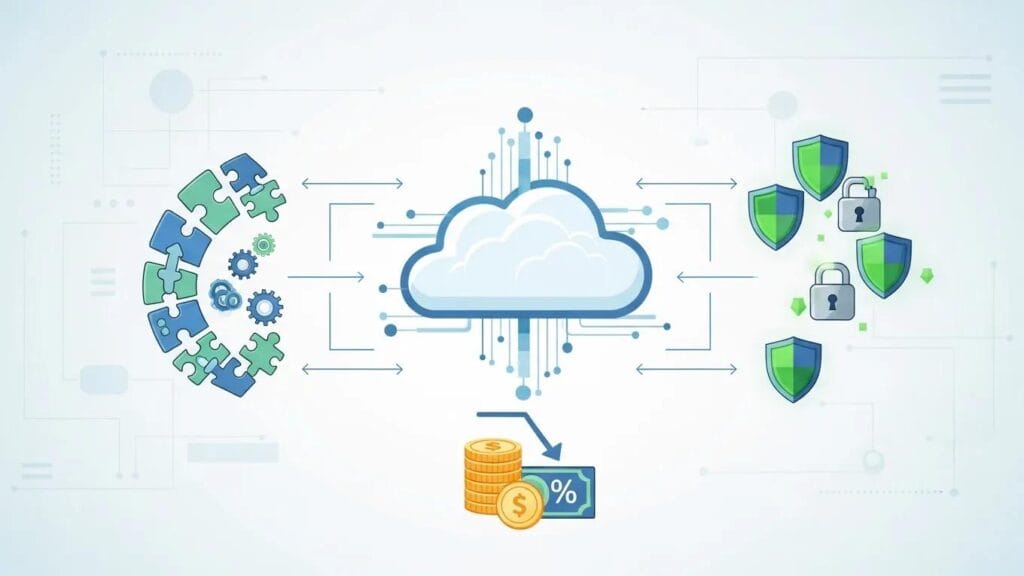
Scalability lets businesses add capacity quickly during peak periods or traffic spikes. Cloud platforms offer security measures such as data encryption and automated backups to protect sensitive information. Moving from capital expenditure (CapEx) to operational expenditure (OpEx) means organizations pay for actual usage, reducing upfront spend and avoiding wasted resources.
Perceived Business Benefits of Cloud Computing
This study examined adopters’ perceived benefits of cloud computing and assessed how moderating factors like firm size and value-chain activities influenced that relationship. Researchers used a 5-point Likert scale with businesses of varying sizes in Taiwan. The cloud computing benefits evaluated were cost reduction, improved capability, and enhanced scalability.
The perceived business benefit of cloud computing: An exploratory study, TT Chuang, 2016
How Does SaaS Subscription Management Simplify Enterprise Cloud Adoption?
SaaS subscription management reduces the friction of adopting cloud software. By providing internet-based access on a subscription basis, SaaS removes heavy infrastructure and lets teams scale access as needs change while keeping costs predictable.
Streamlining Procurement and Provisioning of Cloud Software

SaaS centralises procurement and provisioning so organizations can evaluate solutions faster and use analytics to choose the best fit, speeding implementation and letting teams adapt tools to evolving business needs without lengthy infrastructure projects.
SaaS ERP Adoption and Benefits for Small and Medium-sized Businesses
Cloud-delivered Enterprise Resource Planning (ERP) systems let small and medium-sized enterprises access ERP functionality without the capital and management burden of on-premise deployments. This study used a cross-sectional field investigation across four case study organizations to explore drivers and challenges affecting SME adoption of SaaS ERP systems. Adoption of software as a service (SaaS) enterprise resource planning (ERP) systems in small and medium sized enterprises (SMEs), R Seethamraju, 2013
Aloye, a lead generation and information hub, recognises the role of effective SaaS solutions in driving business growth. By using advanced SaaS products, organizations can improve operational efficiency and simplify workflows.
What Are Best Practices for Enterprise Cloud Migration Strategies?
A clear migration plan reduces disruption and maximises cloud benefits: start with a thorough assessment of current infrastructure, then prioritise the most critical applications and data for migration to ensure business continuity.
Security and Compliance Considerations During Migration
Security and compliance should guide migration decisions. Conduct risk assessments, protect sensitive data, and verify regulatory requirements. Working with a trusted cloud provider strengthens your security posture during and after the migration.
Secure Cloud Migration Strategies in Enterprise Modernization
The push for digital transformation has driven enterprises to modernize legacy data centers and move to cloud infrastructures. Secure cloud migration enables scalability, cost efficiency, and operational agility while introducing new security and compliance challenges. This paper provides an analysis of secure cloud migration strategies for enterprise data center modernization.
Secure cloud migration strategies for enterprise data center modernization, R Adepu, 2024
How Can Businesses Optimize Costs and Manage Cloud Subscriptions Effectively?
To optimise cloud spend, monitor usage and identify underutilised services. Regular reviews of cloud subscriptions reveal opportunities to reduce costs and reallocate resources more efficiently.
Tools and Automation for Efficient Multi-Cloud Management
Use tools and automation to manage multi-cloud environments efficiently. Common options include:
- Cloud Cost Management Platforms: Tools that provide visibility into cloud spending, helping businesses identify waste and optimize resource usage.
- Automated Alerts: Notifications to stakeholders when spending metrics exceed predefined thresholds, ensuring proactive cost management.
- Resource Scheduling Tools: Automate deallocation of unused resources after business hours to save costs.
These tools improve visibility and control across cloud environments, helping organisations make better decisions and reduce unnecessary spending.
SaaS subscription plans offer different feature sets and price points; businesses should evaluate options to balance functionality and cost for their specific needs.
| SaaS Plan Type | Features | Pricing |
|---|---|---|
| Basic | Essential tools with limited storage | $10/month |
| Standard | Enhanced features with increased storage | $25/month |
| Premium | All features with unlimited storage | $50/month |
The table illustrates why matching plan features to business requirements matters—choose the option that delivers the right capabilities at an acceptable cost.
Frequently Asked Questions
What types of businesses can benefit from cloud services?
Cloud services suit startups, small and medium enterprises (SMEs), and large corporations. Startups reduce overhead, SMEs gain scalable tools without big capital investments, and large firms can streamline operations and centralise data management across departments. In short, businesses of all sizes can leverage cloud services to innovate and improve efficiency.
How does cloud computing enhance data security?
Cloud providers implement encryption, identity and access management, and regular security audits to protect data. Features like two-factor authentication, firewalls, automatic backups, and disaster recovery help prevent loss and speed recovery. Access to dedicated security teams also lets organisations focus on core activities with greater confidence in their data protection.
What factors should businesses consider when selecting a cloud provider?
Evaluate security and compliance policies, service level agreements (SLAs), pricing models, and customer support. Confirm regulatory compliance (e.g., GDPR or HIPAA), review uptime guarantees and support response times, and check for hidden fees. Reliable support and a proven track record are key selection criteria.
Can cloud services integrate with existing on-premises infrastructure?
Yes. Hybrid cloud architectures and integration tools enable seamless data and application exchange between on-premises systems and cloud environments. This lets organisations retain current investments while migrating workloads incrementally, reducing downtime and disruption.
What are common challenges businesses face when migrating to the cloud?
Typical challenges include security concerns, application compatibility, and complex migration planning. Data exposure risks, incompatible legacy apps, and logistical planning can complicate moves. Providing staff training and strong change management reduces friction and improves adoption.
How does multi-cloud management work?
Multi-cloud management oversees services across multiple providers, allowing businesses to use each provider’s strengths. Management platforms monitor resources, optimise performance, and control costs to increase flexibility, resilience, and to reduce vendor lock-in.
Conclusion
Cloud services deliver flexibility, security, and cost efficiency that position businesses to compete and grow. A solid understanding of cloud infrastructure and SaaS solutions helps organisations streamline operations and drive results. Explore our resources and expert insights to learn more and take the next step in your cloud journey.